Toolbox Chaos practical guide
Compare Integration Methods
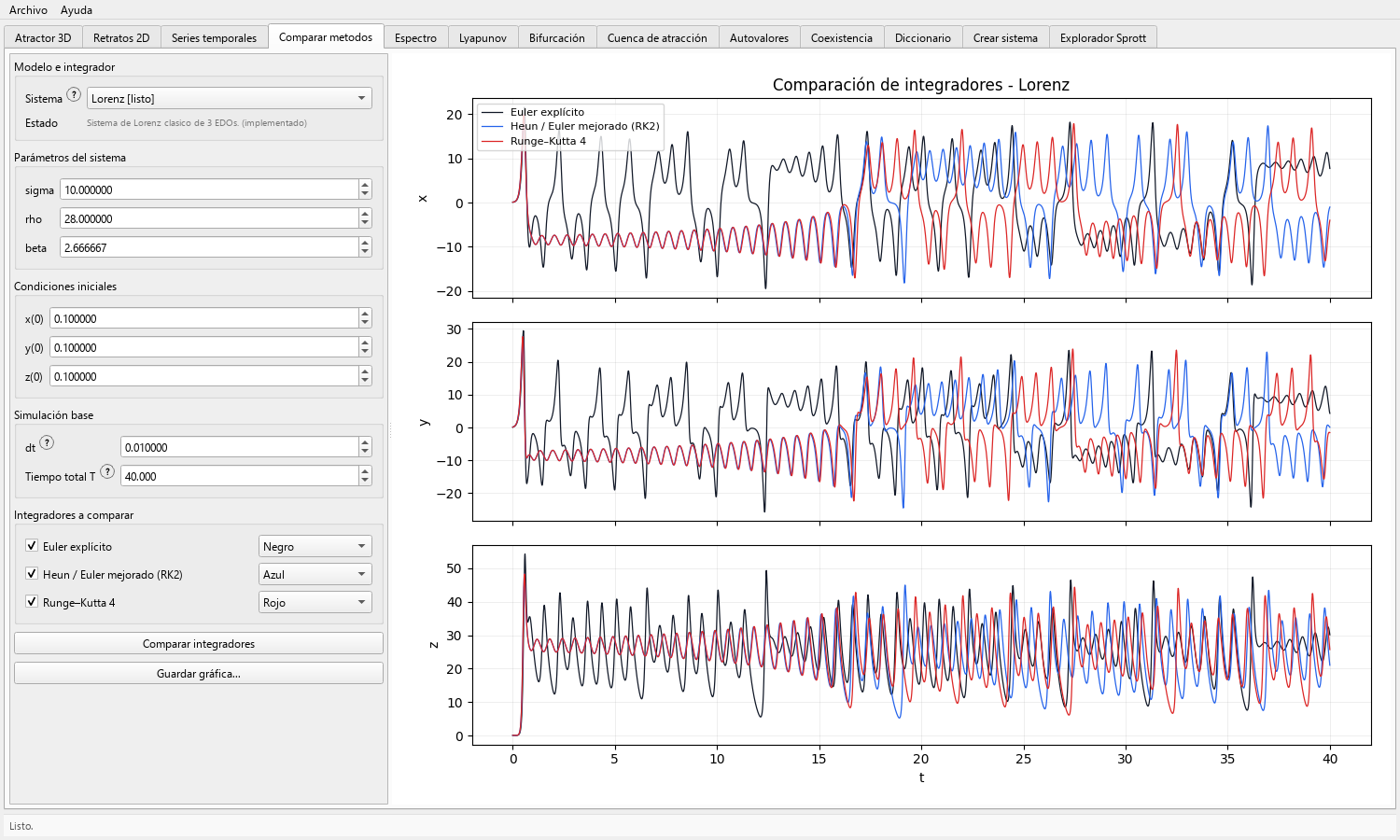
Run Euler, Heun, and RK4 on a compatible continuous ODE flow under the same inputs, interpret finite-horizon separation, and design a defensible step-refinement check.
Objective
What you will accomplish
Evaluate numerical sensitivity for a compatible ODE flow without confusing solver disagreement with a newly discovered dynamical effect.
Before you begin
- Use a compatible continuous ODE flow, preferably a supported three-state catalog case such as Lorenz, Rossler, or Chua, with a fixed parameter vector, initial condition, step, and duration.
- Do not use this tutorial for discrete maps, Mackey–Glass delay dynamics, or Lorenz-96; their update contracts are not an effective Euler/Heun/RK4 comparison in this panel.
- Understand that sensitive trajectories can diverge pointwise even when two reliable methods reproduce the same statistical regime.
Reference outputs
What these views can show
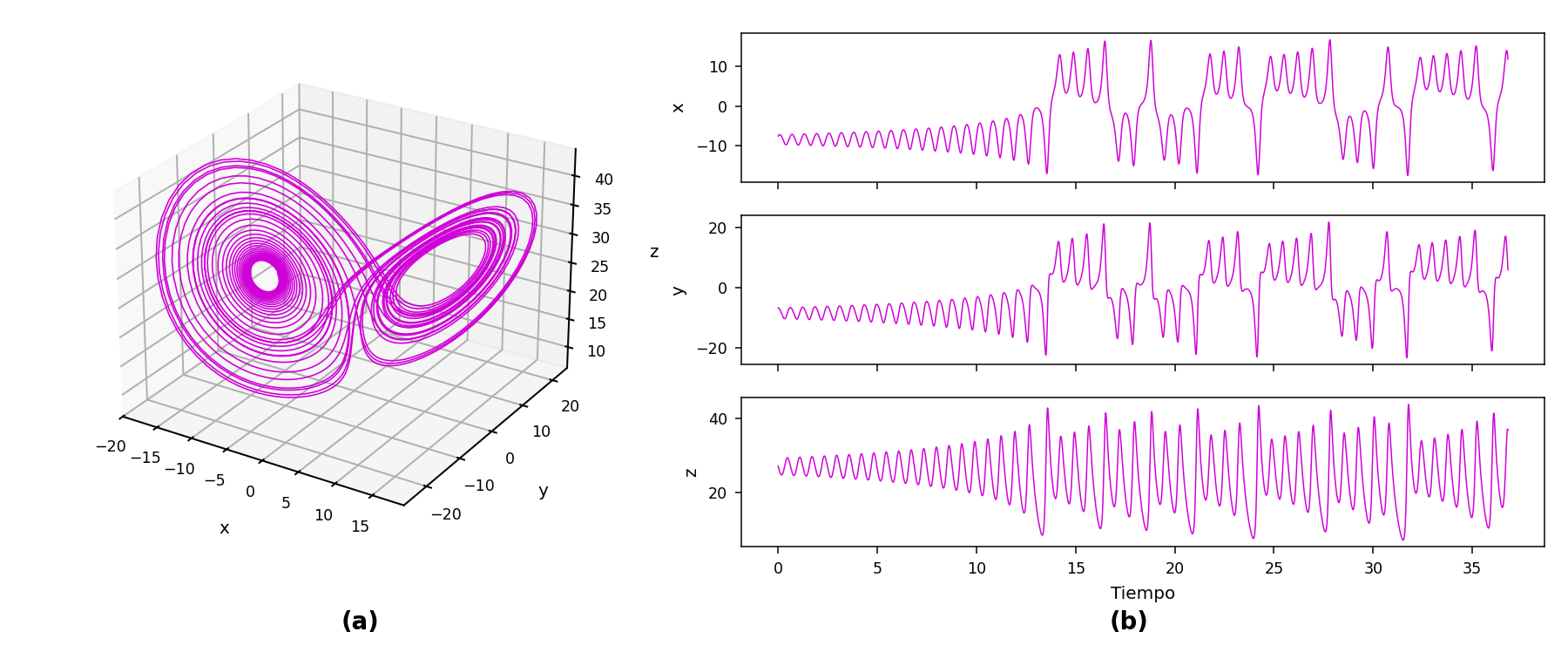
Procedure
Step-by-step workflow
-
Define a common experiment
Select one compatible continuous ODE flow, its parameters, one initial state, step dt, and duration T. These values are shared by all checked methods.
Begin with a moderate duration so early error growth can be read before long-time sensitive divergence dominates.
-
Select the methods
Enable Euler explícito, Heun / Euler mejorado, and Runge–Kutta 4. Assign distinct high-contrast colors.
All three are fixed-step methods in this interface; the comparison does not include adaptive error-controlled integration.
-
Generate the overlay
Press Comparar integradores and inspect early agreement, phase drift, amplitude changes, boundedness, and any method-specific failure.
Do not infer that the most visually complex trace is the most accurate one.
-
Repeat at half the step
Keep model, initial state, and horizon fixed; halve dt and regenerate the overlay.
Look for improved early agreement and convergence of bounded regions, dominant frequencies, extrema distributions, or other quantities relevant to the study.
-
Separate transient and asymptotic questions
Use a short window to assess local integration agreement and a longer window to compare robust summaries.
If a conclusion changes when halving the step, treat it as numerically unresolved rather than selecting the preferred-looking run.
-
Export a comparison record
Save the comparison figure for each tested step and name the files with the step and horizon.
Report the list of enabled methods; do not write only ‘methods compared’ because unchecked methods are not part of the result.
A practical comparison matrix
- Rows: Euler, Heun, and RK4.
- Columns: dt, dt/2, and—when needed—dt/4.
- Fixed inputs: equations, parameter vector, initial condition, and observation horizon.
- Declared outputs: early-time deviation, boundedness, phase portrait, dominant spectral peaks, or another problem-specific summary.
- Decision: adequate, inadequate, or unresolved at the tested resolution.
Result
Expected output
- An overlay showing where Euler, Heun, and RK4 agree or separate for identical inputs on a compatible ODE flow.
- A two-level step study that indicates whether the qualitative conclusion is stable enough for exploratory use.
Interpretation
How to read it
Early-time agreement that improves with step refinement supports numerical consistency. Late-time separation can be expected in a sensitive system and should not be presented alone as method failure.
A solver that diverges, changes the apparent regime, or retains large discrepancies after refinement signals that the chosen step or method is inadequate for the stated purpose.
Export
Reproducibility checklist
- Record every enabled method, dt, T, parameters, and initial state.
- Export both original-step and refined-step figures.
- State the comparison criterion: early trajectory, geometry, extrema, spectrum, or another declared quantity.
Applications
Where this workflow helps
- Teaching truncation error and numerical sensitivity.
- Selecting a practical method and step before a larger parameter campaign.
- Documenting that a qualitative portrait or diagnostic is not a coarse-step artifact.
Limits
What it does not establish
- The panel compares implemented fixed-step methods; it is not an error estimator or adaptive integrator benchmark.
- This workflow is limited to compatible continuous ODE flows. It does not provide an effective three-integrator comparison for maps, delay equations, or Lorenz-96.
- Pointwise long-time agreement is generally unsuitable as the only criterion for chaotic trajectories.
- Method agreement does not prove chaos, attraction, or hiddenness.